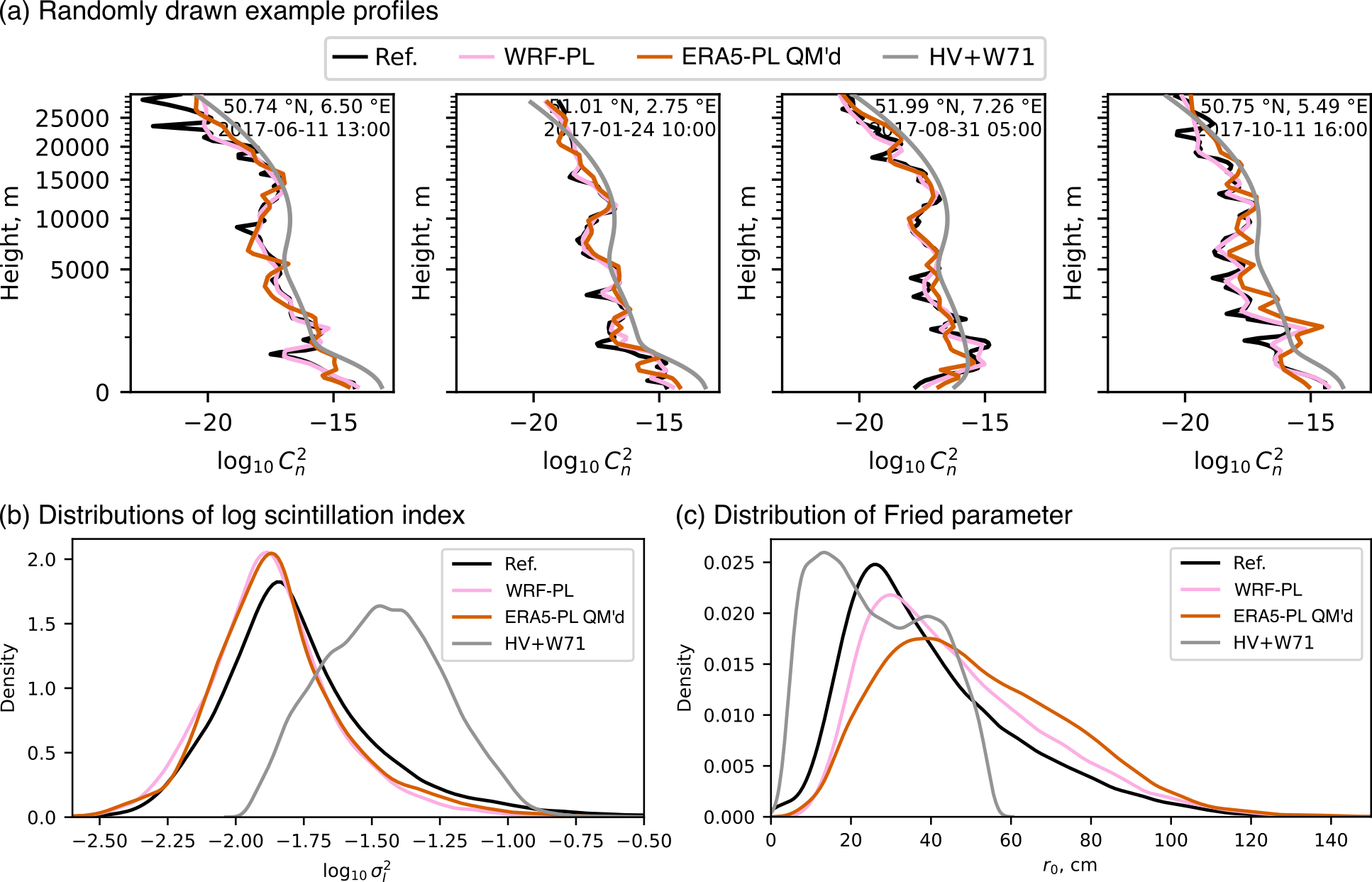
Accurate high-resolution vertical profiles of optical turbulence ($C_n^2$), which reflect local meteorology and topography, are crucial for ground-based optical astronomy and free-space optical communication. However, measuring these profiles or generating them with numerical weather models requires substantial operational or computational effort. In this work, we present OTProf, a deep-learning method that estimates high-resolution $C_n^2$ profiles from widely available coarse-resolution ERA5 reanalysis data. We evaluate the approach in the Netherlands and compare it with the commonly used Hufnagel-Valley model. Overall, OTProf reproduces the vertical structure of $C_n^2$ more accurately than Hufnagel-Valley and yields more accurate estimates of the Fried parameter $r_0$ and the scintillation index $\sigma_I^2$. As typical in machine learning, the $C_n^2$ predictions are slightly smoothed compared to reference data, especially in cases of rare strong turbulence. This smoothing affects the integrated parameters, sometimes leading to overly optimistic $r_0$ and $\sigma_I^2$ values. Despite this limitation, OTProf offers a more accurate, efficient, and physically consistent alternative to traditional analytical models and computationally expensive mesoscale models.
Recorded talk
I presented this research on 14 April 2026 at the 5th ECMWF-ESA Machine Learning Workshop in Bologna, Italy. You can watch the recording below.