I am fascinated by the idea of solving complex physical modeling problems with data-driven techniques. Currently, I am pursuing my PhD research at the Department of Geoscience and Remote Sensing at TU Delft under the guidance of Sukanta Basu and Rudolf Saathof.

My primary research focus are machine learning models of optical turbulence, i.e., turbulent fluctuations of the refractive index, for free-space optical communication. As side quests, I contributed to deep learning downscaling of weather model output and deep learning interpolation of weather station observations.

Work

M. Pierzyna, S. Basu, R. Saathof

OTProf: estimating high-resolution profiles of optical turbulence ($C_n^2$) from reanalysis using deep learning

arXiv (submitted to journal) (2026) | Full text | Code
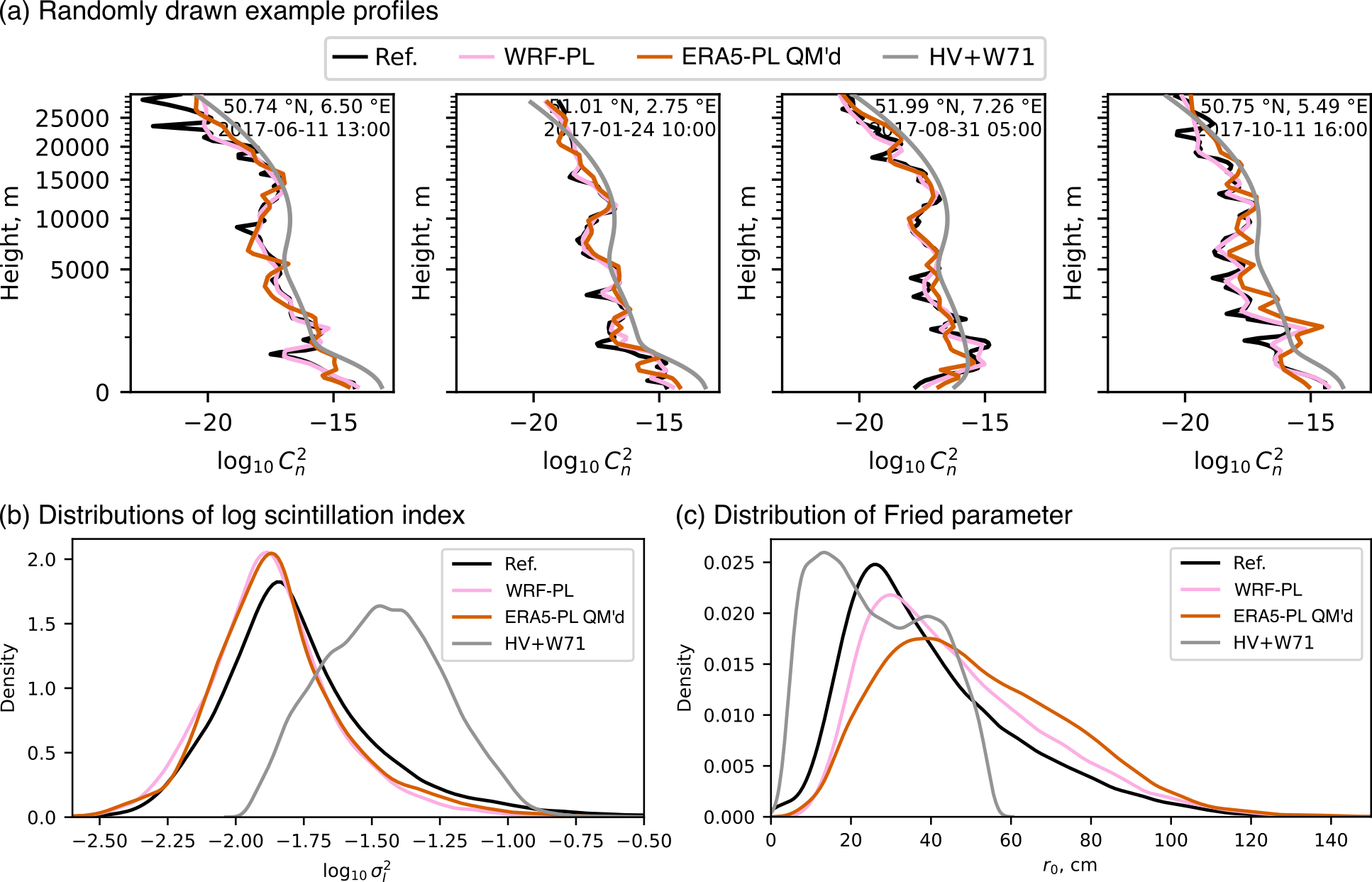
Comparison of estimated (a) profiles and (b+c) column-integrated astroclimate parameters against meoscale model baseline (Ref) and traditional analytical baseline (HV+W71).
Figure: Comparison of estimated (a) profiles and (b+c) column-integrated astroclimate parameters against meoscale model baseline (Ref) and traditional analytical baseline (HV+W71).

Accurate high-resolution vertical profiles of optical turbulence ($C_n^2$), which reflect local meteorology and topography, are crucial for ground-based optical astronomy and free-space optical communication. However, measuring these profiles or generating them with numerical weather models requires substantial operational or computational effort. In this work, we present OTProf, a deep-learning method that estimates high-resolution $C_n^2$ profiles from widely available coarse-resolution ERA5 reanalysis data. We evaluate the approach in the Netherlands and compare it with the commonly used Hufnagel-Valley model. Overall, OTProf reproduces the vertical structure of $C_n^2$ more accurately than Hufnagel-Valley and yields more accurate estimates of the Fried parameter $r_0$ and the scintillation index $\sigma_I^2$. As typical in machine learning, the $C_n^2$ predictions are slightly smoothed compared to reference data, especially in cases of rare strong turbulence. This smoothing affects the integrated parameters, sometimes leading to overly optimistic $r_0$ and $\sigma_I^2$ values. Despite this limitation, OTProf offers a more accurate, efficient, and physically consistent alternative to traditional analytical models and computationally expensive mesoscale models.

M. Pierzyna, R. Saathof, S. Basu

Tailor-made data-driven similarity theories for the temperature structure parameter $C_T^2$ in the lower atmospheric boundary layer

AMS Boundary Layers & Turbulence Meeting (2025) | Full text
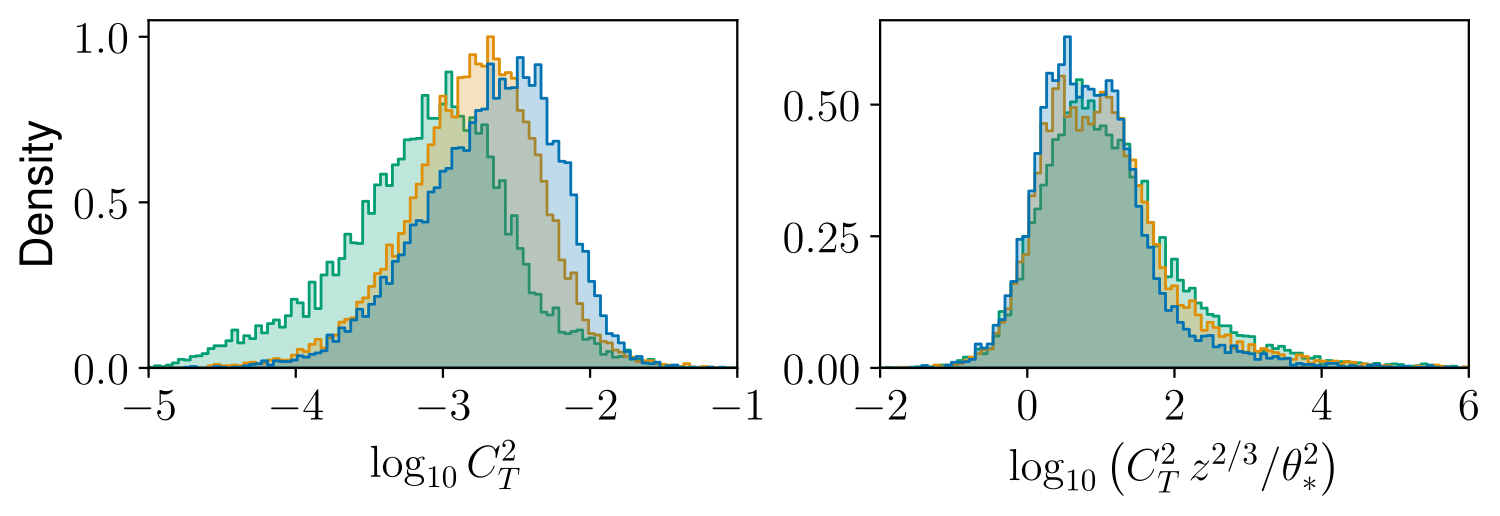
Collapse of $C_T^2$ distributions observed at 60m (blue), 100m (orange), and 180m (green) height after applying non-dimensional scaling obtained with Π-ML.
Figure: Collapse of $C_T^2$ distributions observed at 60m (blue), 100m (orange), and 180m (green) height after applying non-dimensional scaling obtained with Π-ML.

Optical ground-based astronomy and future free-space optical communication (FSOC) suffer from light getting distorted when it propagates through the turbulent atmosphere. In astronomy, turbulent fluctuations of the atmospheric refractive index, known as optical turbulence (OT), cause blurry images and limit the detection of small objects. FSOC links, which use optical beams to transmit data instead of traditional radio waves, experience reduced data rates or even link interruptions due to laser beams getting distorted by OT. ...

M. Pierzyna, S. Basu, R. Saathof

OTCliM: generating a near-surface climatology of optical turbulence strength ($C_n^2$) using gradient boosting

Artifical Intelligence for the Earth Systems (2025) | Full text | Code
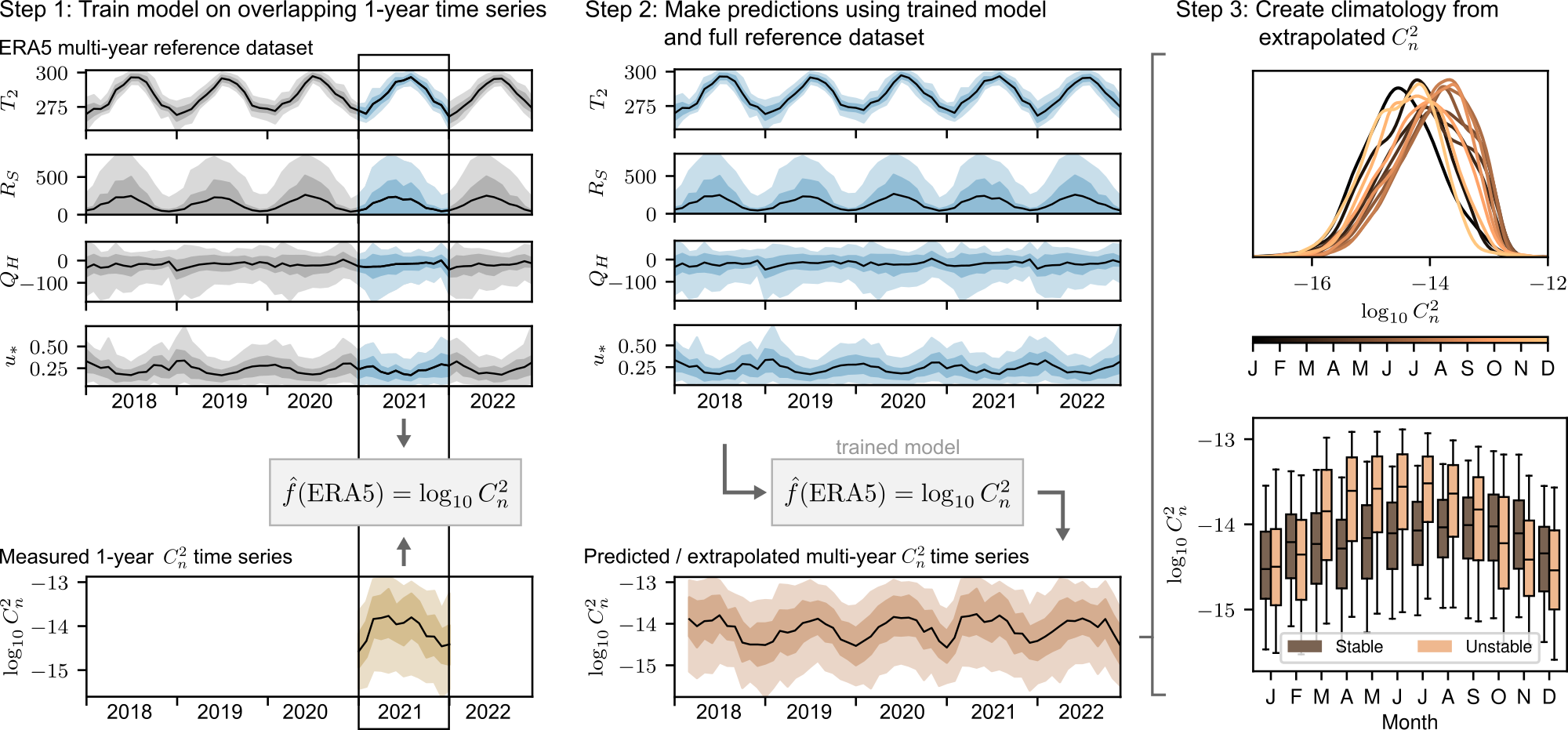
Proposed OTCliM approach to extrapolate a measured 1-year time series of optical turbulence strength (yellow) to multiple years (orange) based on ERA5 reference data (blue).
Figure: Proposed OTCliM approach to extrapolate a measured 1-year time series of optical turbulence strength (yellow) to multiple years (orange) based on ERA5 reference data (blue).

This study introduces OTCliM (Optical Turbulence Climatology using Machine learning), a novel approach for deriving comprehensive climatologies of atmospheric optical turbulence strength ($C_n^2$) using gradient boosting machines. OTCliM addresses the challenge of efficiently obtaining reliable site-specific $C_n^2$ climatologies, crucial for ground-based astronomy and free-space optical communication. Using gradient boosting machines and global reanalysis data, OTCliM extrapolates one year of measured $C_n^2$ into a multi-year time series. We assess OTCliM’s performance using $C_n^2$ data from 17 diverse stations in New York State, evaluating temporal extrapolation capabilities and geographical generalization. Our results demonstrate accurate predictions of four held-out years of $C_n^2$ across various sites, including complex urban environments, outperforming traditional analytical models. Non-urban models also show good geographical generalization compared to urban models, which capture non-general site-specific dependencies. A feature importance analysis confirms the physical consistency of the trained models. It also indicates the potential to uncover new insights into the physical processes governing $C_n^2$ from data. OTCliM’s ability to derive reliable $C_n^2$ climatologies from just one year of observations can potentially reduce resources required for future site surveys or enable studies for additional sites with the same resources.

M. Pierzyna, O. Hartogensis, S. Basu, R. Saathof

Intercomparison of flux, gradient, and variance-based optical turbulence ($C_n^2$) parameterizations

Applied Optics (2024) | Full text | Code
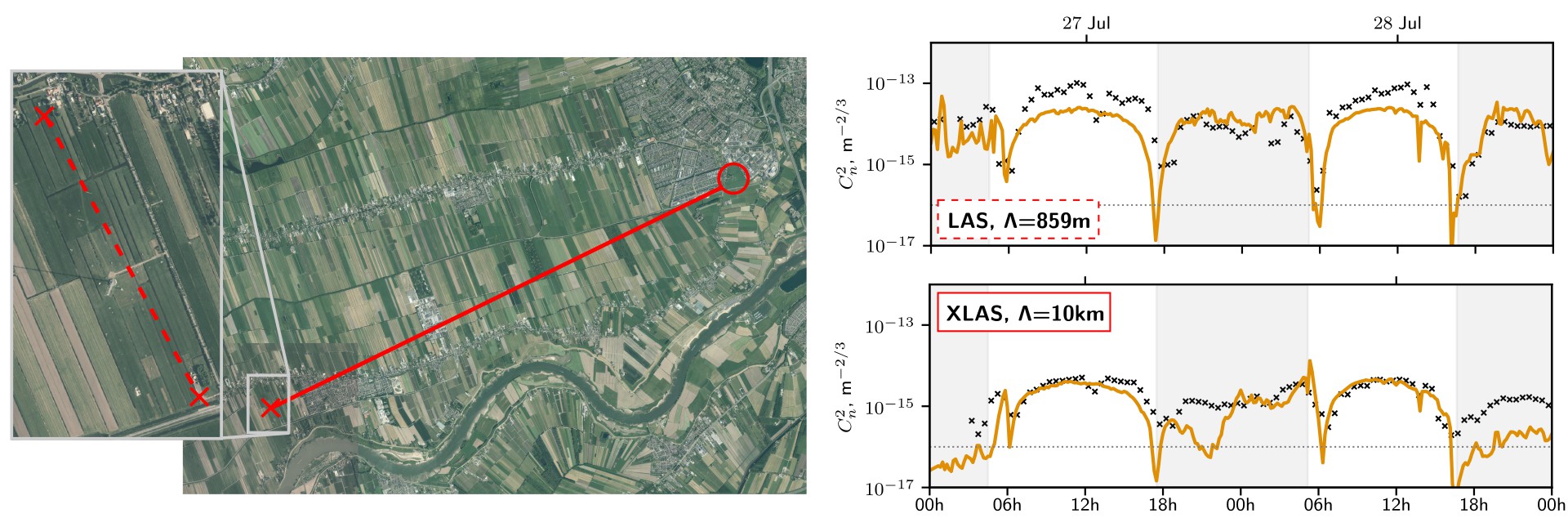
Comparision of $C_n^2$ (markers) observed at two levels with $C_n^2$ time series (line) estimated from mesoscale simulations using a variance-based parameterization.
Figure: Comparision of $C_n^2$ (markers) observed at two levels with $C_n^2$ time series (line) estimated from mesoscale simulations using a variance-based parameterization.

For free-space optical communication (FSOC) or ground-based optical astronomy, abundant data of optical turbulence strength ($C_n^2$) is imperative but typically scarce. Turbulence conditions are strongly site-dependent, so their accurate quantification requires in-situ measurements or numerical weather simulations. If $C_n^2$ is not measured directly, e.g., with a scintillometer, $C_n^2$ parameterizations must be utilized to estimate $C_n^2$ from meteorological observations or model output. Even though various such parameterizations exist in the literature, their relative performance is unknown. We fill this knowledge gap by performing a systematic three-way comparison of a flux-based, a gradient-based, and a variance-based parameterization. Each parameterization is applied to both observed and simulated meteorological variables, and the resulting $C_n^2$ estimates are compared against observed $C_n^2$ from two scintillometers. The variance-based parameterization yields the overall best performance, and unlike other approaches, its application is not limited to the lowest part of the atmospheric boundary layer, i.e., the surface layer. We also show that $C_n^2$ estimated from the output of the Weather Research and Forecasting (WRF) model aligns well with observations, highlighting the value of mesoscale models for optical turbulence modeling. ...

M. Pierzyna

KelpNet: Probabilistic Multi-Task Learning for Satellite-Based Kelp Forest Monitoring

ESA-ECMWF ML4EOPS (2024) | Full text | Code
M. Pierzyna, R. Saathof, S. Basu

A multi-physics ensemble modeling framework for reliable $C_n^2$ estimation

Environmental Effects on Light Propagation and Adaptive Systems VI (2023) | Full text
M. Pierzyna, R. Saathof, S. Basu

Π-ML: A dimensional analysis-based machine learning parameterization of optical turbulence in the atmospheric surface layer

Optics Letters (2023) | Full text | Code
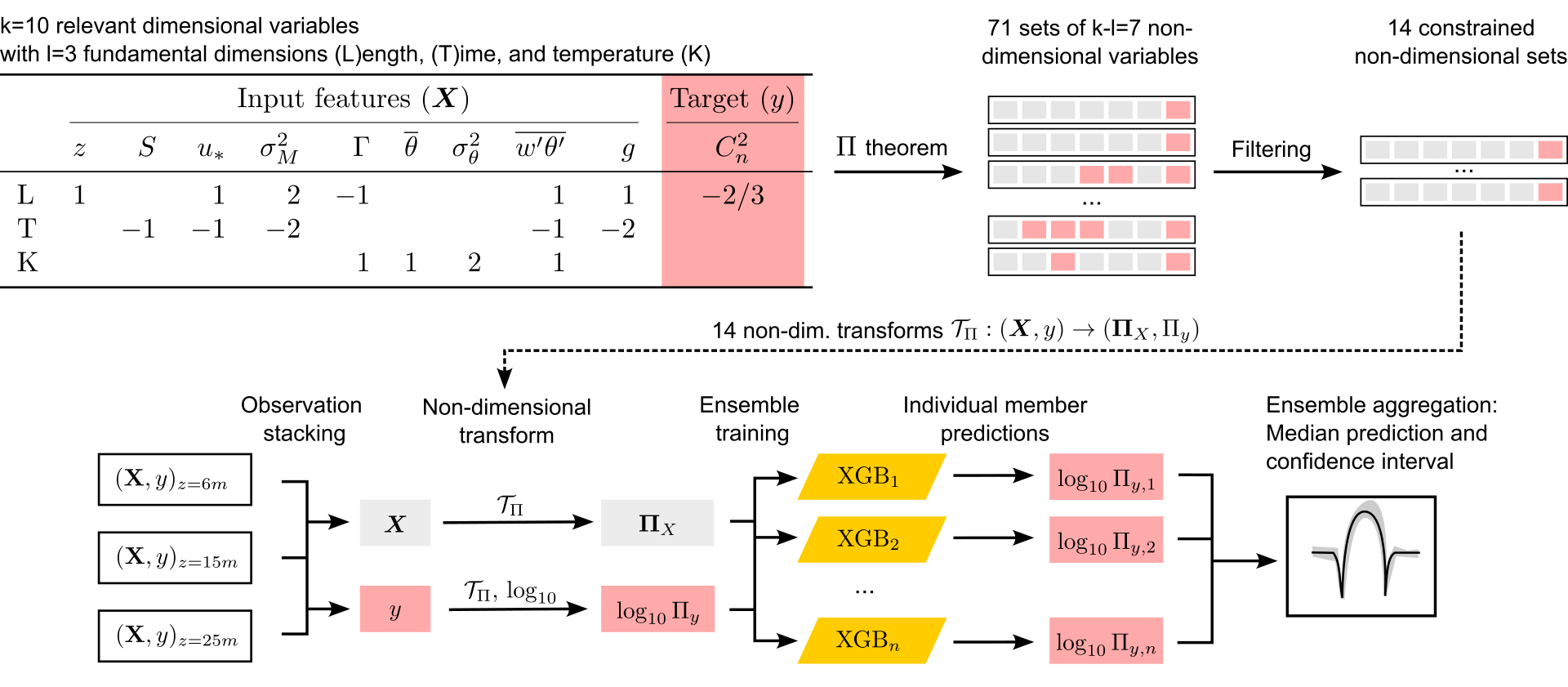
The two components of our Π-ML approach: Combination of dimensional variables into non-dimensional Π-variables and the subsequent XGBoost ensemble training.
Figure: The two components of our Π-ML approach: Combination of dimensional variables into non-dimensional Π-variables and the subsequent XGBoost ensemble training.

Turbulent fluctuations of the atmospheric refraction index, so-called optical turbulence, can significantly distort propagating laser beams. Therefore, modeling the strength of these fluctuations ($C_n^2$) is highly relevant for the successful development and deployment of future free-space optical communication links. In this letter, we propose a physics-informed machine learning (ML) methodology, Π-ML, based on dimensional analysis and gradient boosting to estimate $C_n^2$. Through a systematic feature importance analysis, we identify the normalized variance of potential temperature as the dominating feature for predicting $C_n^2$. For statistical robustness, we train an ensemble of models which yields high performance on the out-of-sample data of $R^2=0.958\pm0.001$. ...

M. Pierzyna, D. A. Burzynski, S. E. Bansmer, R. Semaan

Data-driven splashing threshold model for drop impact on dry smooth surfaces

Physics of Fluids (2021) | Full text | Code